Payday Super Explained: What It Means for Individual Employees in Australia
6/11/20262 min read
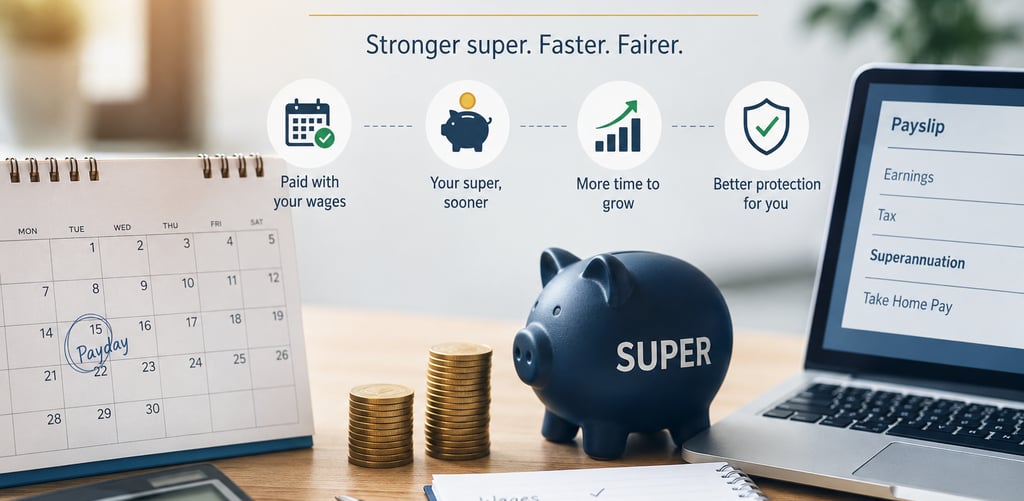
For many Australians, superannuation is something they only think about when checking their super balance or planning for retirement. However, from 1 July 2026, the Australian Government is introducing Payday Super, a major reform that changes when employers must pay super contributions.
Here's what it means for you as an employee.
What is Payday Super?
Under the current rules, employers are generally required to pay your compulsory superannuation contributions to your super fund at least once every quarter.
With Payday Super, employers will be required to pay your super at the same time they pay your wages or salary. Instead of waiting until the end of the quarter, your super will be processed alongside each pay cycle—whether you're paid weekly, fortnightly or monthly.
The amount of super you receive does not change. What changes is how quickly it reaches your super account.
Why is the Government Introducing Payday Super?
The reform aims to:
Ensure employees receive their super on time.
Reduce unpaid or late super.
Improve transparency by allowing employees to see contributions much sooner.
Help retirement savings grow earlier through compound investment returns.
Many employees currently discover missing super months after it should have been paid. Payday Super is designed to reduce this issue.
What Does This Mean for Employees?
1. Your Super Will Reach Your Account Sooner
Rather than waiting until the employer's quarterly due date, contributions will generally be made each payday.
This means you'll be able to see your super contributions appearing in your account much more regularly.
2. Your Retirement Savings May Grow Faster
Money invested earlier has more time to earn investment returns.
Even though the difference may seem small from each pay, receiving super throughout your working life can result in a larger retirement balance due to compound growth.
3. It's Easier to Spot Missing Super
Regular payments make it much easier to notice if a contribution hasn't been received.
Instead of waiting months before identifying an issue, employees can follow up much sooner with their employer.
4. Greater Financial Transparency
Employees will have a clearer picture of:
How much super they're receiving.
Whether their employer is paying correctly.
Their growing retirement savings throughout the year.
Will Your Take-Home Pay Change?
No. Payday Super does not increase or reduce your salary.
Your employer will continue paying compulsory super based on the applicable Superannuation Guarantee rate. The only change is when those contributions are paid.
Does This Affect All Employees?
The reform is expected to apply to most employees who are entitled to compulsory super contributions under the Superannuation Guarantee rules.
What Should Employees Do?
Although your employer is responsible for making the payments, employees should still:
Regularly check their super account.
Confirm contributions are arriving after each pay cycle.
Keep their super fund details up to date with their employer.
Contact their employer promptly if expected contributions are missing.
Disclaimer: This article is general information only and should not be relied upon as taxation or financial advice. Tax laws may change, and some Budget announcements require legislation before they become law.
Email: info@unlocaladvisory.com
Phone: +61 449 816 733
© 2026. All rights reserved.
Nirmit Bhargava, CPA trading as Unlocal Advisory (cPA pRACTICE)
Liability limited by a scheme approved under Professional Standards Legislation
Unlocal Advisory provides expert accounting, bookkeeping, taxation and advisory services for businesses in Australia. We focus on accuracy, compliance and efficiency while delivering reliable financial support, cost-effective solutions and clear insights that help organisations scale confidently and achieve long-term success.
QUICK LINKS
CONNECT @






REACH OUT FOR TRUSTED SUPPORT
Whatsapp: +61 449 816 733
Website: www.unlocaladvisory.com
individuals & Sole Traders